
.png "English")


By Arnie Coro
radio amateur CO2KK
Hi amigos radioaficionados, welcome once again, to our station's radio hobby program, that is now lasting about 12 minutes on the air and on the world wide web... The scripts are also available at dxersunlimited dot blogspot dot com...
I am Arnie Coro, radio amateur CO2KK, your host here now ready to share with you the most up to date information about our wonderful hobby, yours and mine: RADIO....
Item one: Cuban radio amateurs continue to install 2 meter band FM repeaters all across the Cuban archipelago... the latest one to go on the air is located atop a hill near Santiago de Cuba city. It has two separate antennas in order to optimize the isolation between the receiving and transmitting frequencies. According to the first tests results, the new Santiago de Cuba Puerto Boniato Hill repeater, is providing excellent coverage of several eastern Cuba provinces. It has a standby battery and a Diesel generator to provide power in case of an AC power line failure.
This repeater uses the classic 600 kiloHertz separation between receive and transmit frequencies , so it is fully compatible with stations located not only in Cuba, but also in Jamaica and Haiti, where it can be easily picked up .
Item two: Experimenting with the four diodes Polyakov harmonic mixer receiver, I was able to pick up several 41 meters band short wave broadcast stations by simply zero beatting on their carrier frequency. The high stability Clapp type VFO used by this direct conversion receiver makes possible to listen to the AM broadcasts at exactly zero beat, because the frequency of the VFO is very stable .
This form of receiving an AM station on a direct conversion receiver is known as exalted carrier reception and works very well IF, and I underscore the word IF, the receiver's local injection oscillator frequency can be kept within a few cycles of zero beat with the AM station's carrier.
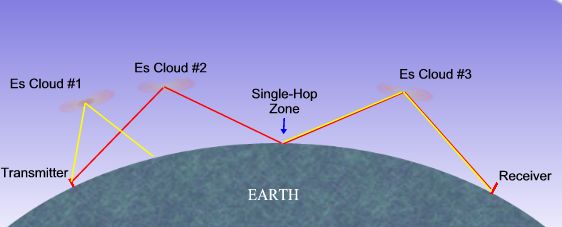
Item three: Answering a listener's question received late Thursday... Yes amigo Raphael, the fast fading is typical of sporadic E propagation events...Like during the fantastic E skip opening that was enjoyed by many North American radio amateurs during Friday late afternoon and evening... During an E skip event at one moment you can pick up a distant FM broadcast station located 800 or 900 miles away with a fantastic signal, and a couple of minutes later the signal is very weak, then it comes back for a few seconds to a very high level, just to vanish again into a deep fade... Sporadic E events may last longer and behave in a much more stable way, but those longer and more stable openings are not as frequent as you and I would like them to happen...
Stay tuned for more radio hobby information coming to you from sunny Havana , where daytime temperatures are peaking now in the region between 30 and 34 degrees Centigrade.
…....
This is Radio Havana Cuba, the name of the show is Dxers Unlimited, and you can get in touch with us by sending an e-mail to inforhc at enet dot cu, again, inforhc at enet dot cu , and VIA AIR MAIL send a postcard to Arnie Coro, Radio Havana Cuba, Havana, Cuba.
Now here is item four: A single sunspot is in sight... it is not a large size active region, but it is there, and scientists think that it will develope into a larger area soon... in the meantime solar activity is at very low levels...
Item five: An odd looking flat plate variable capacitor that uses window glass as its dielectric may be used as part of an antenna tuner when higher powers are involved. The homebrew high voltage glass insulated variable capacitor is a lot easier to build than the typical aluminum plates capacitors used for plate tuning of the high power vacuum tubes final amplifiers and also used by high power antenna tuning units.
Item six: Also antenna tuner related...using a low pass filter between your transceiver or transmitter and the antenna tuner removes the presence of harmonics from the input of the antenna tuner, and this is the way to install the low pass filter and NOT between the tuner and the antenna system.
At CO2KK , my ham radio station , it is possible to operate using 100 Watts to a G5RV antenna without any complaints of TV interference from neighbors.
Normally I run my transceiver at no more than 50 Watts , something that is a good idea, because all radio amateurs must follow the rules and regulations that clearly specify the need to use the lowest possible power output that provide good communications …
As expected, running lower power output to the antennas not only reduced the chances of causing TVI, because by running your ham radio rigs at lower power outputs you not only save electricity and help to reduce carbon dioxide emissions to the atmosphere, but will also extend the life of the power output stages of your transmitter.
Operating ham radio equipment at very low power output levels is quite a challenge... but recent experiments using sophisticated digital modes that are able to literally dig signals well below the noise level have demonstrated once again that QRP operation is possible when running power outputs below the 1 Watt level...
…........................
And now amigos, as always at the end of e show, here is Arnie Coro's Dxers Unlimited's HF propagation update and forecast..
Let's start with the peak of the sporadic E skip season... as we get near to the summer solstice, the number and duration of E skip openings increases signficantly.
This past week I was able to monitor at least three sporadic E openings with one of them, on Friday, passing the 150 megaHertz mark, something that was easy to demonstrate.
I could pick up an FM broadcast station using my small battery operated portable and telescopic whip, the station was located near Chicago , Illinois , and I also heard one 101 megaHertz that was advertising a car dealer located in St Louis , Missouri.
As regards to the HF , the short wave bands propagation, solar activity will continue at very low levels, but new sunspots may appear soon...Catania Observatory Sunspot number for Saturday was 14 and the latest NOAA sunspot number was 18.
Solar flux values will continue to be below 75 units, so really good F2 layer openings on the bands above 14 megahertz will be very rare indeed..
Send your signal reports and comments to inforhc at enet dot cu, or VIA AIR MAIL to Arnie Coro, Radio Havana Cuba, Havana, Cuba... your comments about the program content and radio hobby related questions are much appreciated amigos !
Source: Dxers Unlimited: Dxers Unlimited weekend edition 19 - 20 June http://bit.ly/9nvOPP
(YImber Gaviria, Colombia)
0 comentarios:
Publicar un comentario